Garage Door Track Repair in Silverado Ranch, NV
Silverado Ranch was built on a former floodplain over nearly three decades, and that combination of unstable soil, extreme heat, and a housing stock now deep in its primary failure window creates garage door track problems that are specific to this community.
Why Silverado Ranch Garage Door Track Problems Have Their Own Character
Every other community in this series sits on reasonably stable desert valley floor, former ranchland, or elevated terrain. Silverado Ranch sits on a former alluvial fan a geological formation created by centuries of flash flooding depositing sand, gravel, and sediment from the surrounding mountains onto the valley floor.
The consequence for homebuilding was significant. Developers had to extensively modify the terrain and install flood control infrastructure before construction could proceed. Today the community is dotted with retention basins and engineered drainage channels required infrastructure to manage the monsoon season runoff that still flows from the mountains across Silverado Ranch’s southern and eastern boundaries.
What does this mean for garage door hardware? Two specific things:
Sandy, alluvial soil behavior. The underlying sandy soil in many Silverado Ranch lots compresses and settles differently than the more consolidated desert floor under other communities. In older homes, this settlement can affect the garage floor and wall framing alignment over time subtle but measurable shifts that translate to bracket anchor movement beyond what thermal cycling alone would produce.
Monsoon season moisture near retention basins. During Las Vegas’s July-September monsoon season, the flood retention basins throughout Silverado Ranch fill and slowly release. Homes adjacent to these basins experience elevated moisture levels during and after significant monsoon events enough to accelerate surface rust formation on lower vertical rail sections and bracket hardware near the garage floor. It’s not at Boulder City’s Lake Mead level but it’s more than what purely dry-climate valley communities experience, and it’s worth documenting on inspection.
Construction Timeline — 1996 to 2024, Nearly Three Decades
Silverado Ranch broke ground on its first phase in 1996. The community expanded through the late 1990s, reached its peak during the 2003–2008 Las Vegas construction boom, and continued adding homes through the 2010s and 2020s until the last new home was finally sold in 2024. That’s 28 years of continuous residential construction.
The result is a hardware age range that spans nearly three decades within a single master-planned community:
Late 1990s construction (1996–2001) — the community’s founding neighborhoods. Homes now 23–29 years old. These are the oldest Silverado Ranch properties and the ones most likely to show primary hardware failure. Original torsion springs from this era are at or well past their rated 10,000-cycle life. Original nylon rollers have experienced 20+ desert summers. Bracket anchors from 1990s construction have been through 25+ years of thermal cycling on Las Vegas’s southeast valley floor.
Peak boom construction (2002–2008) — the largest cohort, built when Silverado Ranch was expanding fastest. Homes now 17–23 years old. Like Mountains Edge and Enterprise, the peak-boom construction years produced the most variable garage door installation quality: bracket anchors set without stud confirmation, track spacing imprecisely set for the actual door width, horizontal sections not level from the initial installation. These problems have now had 15–20 years to mature into visible binding, grinding, and mid-travel stops.
Post-recession through recent (2009–2024) — continuing development as Silverado Ranch filled out its remaining lots. Homes range from 1 to 15 years old. Newer properties show installation-phase issues; earlier post-recession homes are entering the first signs of thermal cycling drift.
20+ Builders, 130+ Neighborhoods — The Consistency Problem
Like Mountains Edge, Silverado Ranch’s multi-builder development across decades produced a community where garage door installation quality varies widely by neighborhood, builder, and construction year. The master plan specified land use and infrastructure not garage door hardware standards or installation quality.
Builders active in Silverado Ranch include Pulte Homes, Richmond American Homes, KB Home, Lennar, America West Homes, Astoria Homes, and over a dozen others. Each brought their own subcontractors, their own hardware suppliers, and their own installation practices.
One documented example within Silverado Ranch: Timber Trails (Richmond American) offers 3-car garages and larger floor plans homes with heavier door panels that put more load on the track hardware than what standard builder spec typically assumes. In neighborhoods like Timber Trails where both the door weight and the construction period align with peak-boom variability, we find the track gauge mismatch pattern we document throughout the valley’s luxury neighborhoods.
Across the broader Silverado Ranch community, we approach every call with the same principle as Mountains Edge: the neighborhood tells us what builder was there and roughly what era but we assess what’s actually in the garage rather than assuming.
Southeast Valley Floor — Maximum Heat and UV Exposure
Silverado Ranch sits in the southeast corner of the Las Vegas Valley at one of the lowest elevations in the entire valley approximately 1,900 to 2,100 feet above sea level. This positioning creates the most intense heat and UV conditions of any community in our service area.
Summer afternoon temperatures in southeast Las Vegas consistently exceed 115°F. Garage interiors on south and west-facing walls in Silverado Ranch reach 130–140°F on peak summer days. Combined with the intense UV radiation at low elevation and the maximum sun exposure of the southeast valley’s open terrain, this produces the fastest rubber and nylon degradation in the valley.
Nylon rollers in Silverado Ranch’s 20+ year old homes are frequently more brittle and more degraded than same-age rollers in higher-elevation communities like Summerlin or Centennial Hills. Weather stripping cracks faster. Rubber bumpers and seal components deteriorate sooner. The UV intensity at this elevation and exposure is real, measurable, and shows in the hardware condition on every inspection.
Airport Proximity and Daily Vibration
Harry Reid International Airport is approximately 7 miles north of Silverado Ranch. The community sits directly under or adjacent to landing approach corridors. Residents are accustomed to the sound of aircraft it’s part of the southeast Las Vegas experience.
What most homeowners don’t consider is the vibration component. Low-frequency vibration from aircraft operating overhead, combined with regular road traffic on I-15 and I-215 that borders the community, creates a continuous low-level vibration environment that no other residential community in our service area experiences to the same degree.
Low-frequency vibration accelerates the mechanical loosening of bracket anchors over time. The same thermal cycling that affects every community in the valley produces more cumulative anchor loosening in Silverado Ranch than in a comparably-aged home in a quieter location because the vibration adds micro-cycles of fastener stress on top of the thermal cycling. It’s a subtle factor, but it’s consistent across the community and it compounds over 15–25 years of daily aircraft operations overhead.
HOA Present but Lax — Moderate Maintenance Pressure
Silverado Ranch has HOAs unlike Spring Valley, Sunrise Manor, or Whitney but the HOA structure is described consistently as more relaxed than master-planned communities like Summerlin or Henderson. Monthly fees are moderate ($50–$120). The HOA manages common areas and enforces basic standards but does not conduct systematic property inspections for maintenance issues.
The practical effect on garage door maintenance is a middle-ground position: more external awareness than a no-HOA community, but less rigorous enforcement than Summerlin’s strict community standards. In Silverado Ranch we see homeowners who have generally maintained their properties but may have deferred the garage door for 12–18 months beyond when they noticed the first grinding. Not the multi-year deferrals of Sunrise Manor or Whitney, but typically a delayed call that still results in a more complex repair than would have been needed earlier.
Warning Signs Your Silverado Ranch Track Needs Repair
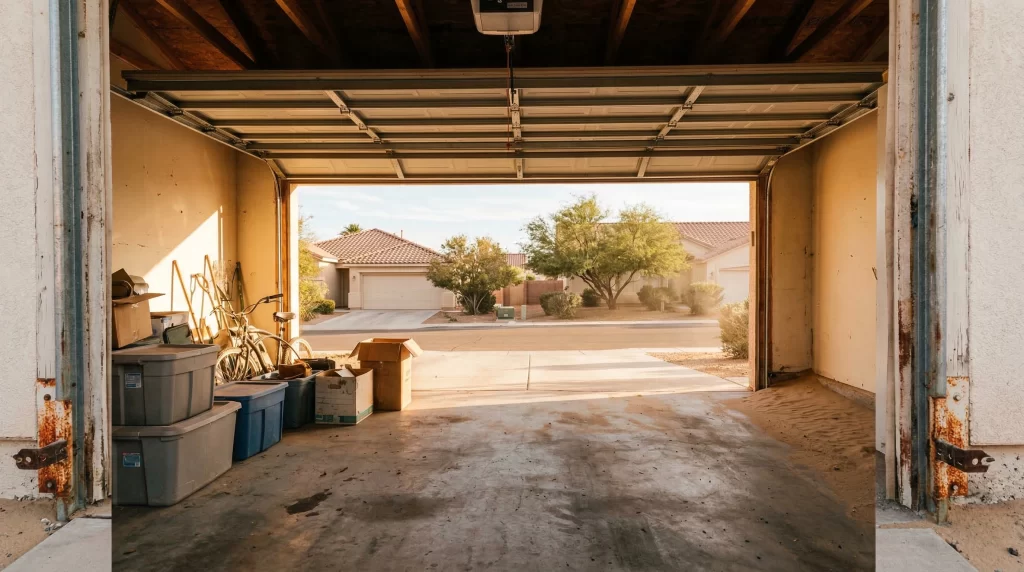
The door stops mid-travel and the opener cuts off Safety override detecting resistance in the travel path. In Silverado Ranch’s founding-era homes (1996–2001) this typically means 20+ years of thermal cycling on southeast valley floor anchors the bracket migration has finally reached the point where the opener can’t push past it. In peak-boom homes (2002–2008) it’s almost always a drywall anchor that was never in solid framing.
Grinding or scraping on every cycle Metal dragging on metal. In southeast Silverado Ranch’s high-UV environment, nylon rollers in 20+ year old homes are particularly brittle and prone to both flat-spotting and cracking at the roller contact point. The combination of degraded rollers and slightly misaligned tracks produces louder, more aggressive grinding than the same condition in higher-elevation communities.
Visible surface rust on lower track sections or brackets More common in Silverado Ranch than in most valley communities particularly in homes near flood retention basins that accumulate seasonal monsoon moisture. Lower vertical rail sections near the garage floor are the most common location. Document it, call us, let us assess whether it’s surface-only or structural.
The door looks uneven or crooked when open One side higher than the other a bracket that has migrated while the other held. In Silverado Ranch’s founding-era homes, the combination of thermal cycling and possible soil settlement under the garage foundation can produce both bracket migration and subtle wall alignment changes that compound over 25+ years.
The door came completely off the track Rollers have exited the rail channel. In founding-era Silverado Ranch homes with original or once-replaced cables, cable failure is a real concern. Do not use the opener. The door is under spring tension. Call us at (702) 937-2911.
The opener strains harder than usual Track friction forcing the motor to work harder. In Silverado Ranch homes where the opener is also 20+ years old, this is the signal to act before the motor fails.
The door reverses automatically instead of closing Force sensor detecting friction and reversing. In Silverado Ranch homes this is almost always track misalignment not a sensor problem. Sensor cleaning doesn’t address bracket migration.
What We Do During Every Silverado Ranch Track Repair Visit
Step 1 — Stabilize and Note the Construction Era and Soil Context
We stabilize the door and release spring tension before any hardware work. In Silverado Ranch we note the construction era and the proximity to flood retention basins as part of our initial assessment because the alluvial fan geology and monsoon moisture factor affect what we expect to find and how we address it.
Step 2 — Full System Inspection Including Rust Assessment
Both vertical rails, both horizontal sections, every mounting bracket, the radius curves, and all ceiling-mount hardware. In Silverado Ranch we specifically document any rust formation at lower rail sections and bracket contact points near the garage floor level a more frequent finding here than in most valley communities.
Step 3 — Root Cause Identification
Thermal cycling bracket migration from 25+ years on the southeast valley floor? Drywall anchor failure from peak-boom construction? Sandy alluvial soil settlement contributing to wall alignment drift? Airport vibration compounding anchor loosening? Heavy door on undersized Timber Trails or similar track? We identify the actual cause.
Step 4 — Repair or Replace the Damaged Section
Bends and crimps that haven’t compromised the rail’s structural integrity can be straightened on-site. We carry standard residential track hardware for sections needing full replacement. In Silverado Ranch homes near retention basins where rust has penetrated to structural compromise at a mounting hole, we replace rather than repair that section.
Step 5 — Re-Anchor Every Bracket Into Solid Framing
The critical step in Silverado Ranch’s founding-era homes especially. Original 1990s construction anchors have experienced 25+ years of thermal cycling, low-frequency airport vibration, and in some cases the minor settlement effects of alluvial fan soil. We locate every stud, pull any anchor that has failed or migrated, and re-anchor into solid framing.
Step 6 — Roller Inspection, Replacement, and Rust Treatment
We inspect every roller and replace any that are cracked, hardened, or flat-spotted. In Silverado Ranch’s high-UV, high-heat southeast valley position, roller degradation is faster than in most other communities we replace conservatively. Near retention basins we also treat any rust on hardware with a rust-inhibiting compound before lubricating.
Step 7 — Precision Alignment Verification
We use a level to confirm both vertical tracks are plumb, both horizontal sections are level, and clearance is consistent throughout travel. In Silverado Ranch’s founding-era homes we take additional care to verify the track alignment relative to the actual garage opening because 25+ years of alluvial fan soil settlement can produce subtle garage frame movement that compounds bracket migration.
Step 8 — Clean, Lubricate, and Full Test Cycle
We clean the full track interior removing desert grit and old lubricant. In retention-basin-adjacent properties we apply a rust-inhibiting silicone-based lubricant. We run the door through multiple complete cycles before leaving.
Repair vs. Replace — Our Honest Call for Silverado Ranch Homes
We Repair When:
- Bracket migration from thermal cycling or drywall anchor failure most common in founding-era and peak-boom homes
- Surface rust only no structural compromise at mounting holes
- The rail is structurally intact no cracks or splits
- The door came off track due to roller or cable failure, not rail structural failure
We Recommend Replacement When:
- The rail has cracked or split at mounting holes more likely in founding-era 1990s homes with 25+ years of combined thermal cycling and vibration fatigue
- Rust has penetrated to structural metal loss near a retention basin actual metal compromise, not surface discoloration
- The track gauge is undersized for the actual door weight specific concern in Timber Trails and similar 3-car garage configurations
- The hardware is a multi-era assembly from conversion or mismatched repairs that cannot be consistently aligned
When replacement is the right call, we explain exactly why before any work begins. Then we complete it the same day in most cases.
What Does Garage Door Track Repair Cost in Silverado Ranch, NV?
| Service | Typical Price Range |
|---|---|
| Track realignment — bracket re-anchoring, no rail damage | $95 – $175 |
| Bent section repair — straightening + re-anchoring | $125 – $200 |
| Single track section replacement | $175 – $275 |
| Full track replacement, both sides | $300 – $450 |
| Track repair + roller replacement combined | $200 – $350 |
Our $49 service call fee applies toward any repair completed on the same visit. Exact price before we start not an estimate that changes after the diagnosis.
If we find related issues cables showing wear, a spring at or past cycle life, or weather stripping cracked from southeast UV intensity we tell you and let you decide. No pressure. No bundling.
A Real Silverado Ranch Call — Founding-Era Home, Near Retention Basin

A homeowner in one of Silverado Ranch’s founding-era neighborhoods off Bermuda Road called us on a Monday morning. Their two-car garage door on a home built in 1999 had been making a grinding noise for about three months and that morning had stopped about four feet from the fully closed position. The car was inside.
When we arrived the hardware told a clear story. Both lower vertical rail brackets had partially separated from the wall original 1999 construction anchors into drywall, no stud contact on either side. Additionally, the lower sections of both vertical rails showed moderate surface rust at the bracket contact points and along the bottom six inches of the rails near the garage floor. The home was approximately 150 feet from one of the neighborhood’s flood retention basins close enough that monsoon season brought elevated moisture to the garage floor level annually.
We located the studs behind both failed bracket positions, pulled the original drywall anchors, re-anchored both brackets into solid framing, treated the surface rust on the lower rail sections with a rust-inhibiting compound, replaced four rollers two with flat spots, two showing UV-related cracking consistent with 25 years of southeast valley sun exposure and lubricated the system with a rust-inhibiting formulation appropriate for the moisture exposure level.
We also found the right-side ceiling mount on the horizontal section had partially pulled from drywall above. We re-anchored it into the joist while on site.
Total time: 100 minutes. Cost: $245.
Three months of grinding. Twenty-five years of combined thermal cycling, airport vibration, and annual monsoon moisture. One hundred minutes to address it completely.
Silverado Ranch Neighborhoods and Areas We Serve
A1 Local Garage Door covers all of Silverado Ranch including:
- Founding-era neighborhoods (1996–2001) — Bermuda Road and Silverado Ranch Boulevard corridor; oldest Silverado Ranch homes at 23–29 years; original hardware most at risk; alluvial fan soil settlement effects most pronounced
- Peak-boom expansion (2002–2008) — largest cohort; boom-era installation variability; drywall anchors most common; homes 17–23 years old entering or in primary failure window
- Timber Trails and similar Richmond American neighborhoods — 3-car garage configurations; heavier door loads; track gauge assessment essential
- Gated communities throughout Silverado Ranch — moderate HOA oversight; mix of construction eras; standard community assessment approach
- Homes adjacent to flood retention basins — elevated moisture exposure during monsoon season; rust assessment and rust-inhibiting lubrication part of standard service
- Post-recession and newer construction (2009–2024) — ranging from near-new to 15-year-old hardware; installation-phase issues primary concern for newer homes; thermal cycling drift for older post-recession builds
- Las Vegas Boulevard South border properties — some with Las Vegas addresses, some Henderson; we serve all regardless of mailing address
We respond to Silverado Ranch calls within 2–4 hours in most cases. Same-day service available seven days a week.
Get Your Garage Door Inspected for Just $49
A quick inspection today can prevent a complete breakdown tomorrow.
Any Repair of $500 or More
Terms: Residential only. Cannot be combined with other offers. Mention this offer when booking
FAQs - Track Repair Silverado Ranch NV
How much does garage door track repair cost in Silverado Ranch, NV?
Most repairs fall between $95 and $275. Full two-side track replacement runs $300–$450. Exact price before we start. Our $49 service call applies toward any repair done the same visit.
My Silverado Ranch home was built in 1999. Is the original hardware still repairable?
In most cases yes. Founding-era Silverado Ranch hardware is typically structurally sound rail that needs bracket re-anchoring and roller replacement rather than full rail replacement. If we find cracked or rusted-through rails, we’ll tell you honestly that replacement is the better call. We assess before recommending.
I live near one of the retention basins in Silverado Ranch. Does that affect my garage door hardware?
Yes noticeably. Homes within a few hundred feet of flood retention basins see elevated moisture during and after monsoon events. Lower vertical rail sections and bracket bases near the garage floor are the most common locations for rust formation. We document it on every inspection and use rust-inhibiting lubrication for these properties.
Does airport traffic affect my garage door in Silverado Ranch?
Low-frequency vibration from landing approaches contributes to accelerated bracket loosening over time compounding the thermal cycling effect. It’s a consistent factor throughout Silverado Ranch and more pronounced in properties directly under flight paths. It’s one of the reasons we re-anchor every bracket into solid framing rather than just tightening existing anchors.
My door keeps reversing before it closes. I've cleaned the sensors. What's actually wrong?
Almost certainly track misalignment not a sensor issue. When brackets have migrated to the point where the roller creates friction against the track wall, the opener’s force sensor detects that friction and reverses. Sensor cleaning doesn’t address bracket position. Track re-anchoring does.
My Silverado Ranch address says Las Vegas but I'm closer to Henderson. Do you still serve me?
Yes we serve all of Silverado Ranch regardless of which mailing address is used. The community straddles the Las Vegas-Henderson border and we cover the entire area.
Do you service Silverado Ranch on weekends?
Yes seven days a week including Saturdays and Sundays. Emergency repair calls answered 24/7.
My door has been grinding for months. Should I call now?
Yes. In Silverado Ranch’s southeast valley heat and UV environment, nylon rollers degrade faster than in higher-elevation communities. What starts as a bracket migration repair can add rollers, cables, or the opener to the bill if left long enough. Calling now keeps it to the simpler repair.
Related Services Silverado Ranch Homeowners Frequently Need
- Garage Door Spring Repair — Founding-era Silverado Ranch homes have original springs at or past rated cycle life
- Garage Door Spring Replacement — Full replacement for springs showing fatigue or past their 10,000-cycle rating
- Garage Door Cable Repair — Cable failure is the most common cause of a door coming off track; monsoon moisture accelerates rust in cables near retention basins
- Garage Door Cable Replacement — Full replacement for cables showing rust or advanced wear
- Garage Door Opener Repair — Track resistance burns out motors; founding-era openers most vulnerable
- Garage Door Opener Replacement — When motor damage from prolonged track strain is beyond repair
- Garage Door Opener Installation — New opener installation for Silverado Ranch homes upgrading aging systems
- Sensor Replacement — Desert dust and monsoon season humidity affect sensor alignment in Silverado Ranch
- Garage Door Maintenance — Annual inspection strongly recommended for all pre-2005 Silverado Ranch homes; semi-annual for retention basin-adjacent properties
- Weather Stripping & Sealing — Southeast valley UV intensity cracks seals faster here than anywhere else in the series
- Emergency Repair — Door stuck open or off-track in Silverado Ranch — 24/7 response
- Garage Door Replacement — Full replacement for founding-era homes where hardware is beyond serviceable repair
- Garage Door Installation — New door installation for Silverado Ranch homes upgrading original systems
Also Serving These Nearby Las Vegas Valley Communities
Need service just outside of Anthem?
Get Your Silverado Ranch Track Repaired Today
Silverado Ranch was built on ground that required an entire flood control system before a home could go up. The hardware in these garages has been cycling through southeast valley heat, airport vibration, and monsoon moisture for up to 25 years. The grinding, the reversal, the mid-travel stop it’s not surprising at this age and in this environment. It’s just time.
Call us now. Exact price before we start. Same-day service. Fixed correctly the first time.
24/7 Live Answering
Need Help Now?






Quick Links
Services
Contact
- 3685 Starship LnLas Vegas, NV 89147
© 2026 A1 Local Garage Door. All Rights Reserved.