What Garage Door Cables Actually Do and Why They Fail Quietly
I’ve been under more garage doors than I can count. And if I had a dollar for every time someone called me saying “my spring broke” when it was actually the cable I’d be retired by now. They’re different parts, but they work together so tightly that when one goes, the other looks guilty.
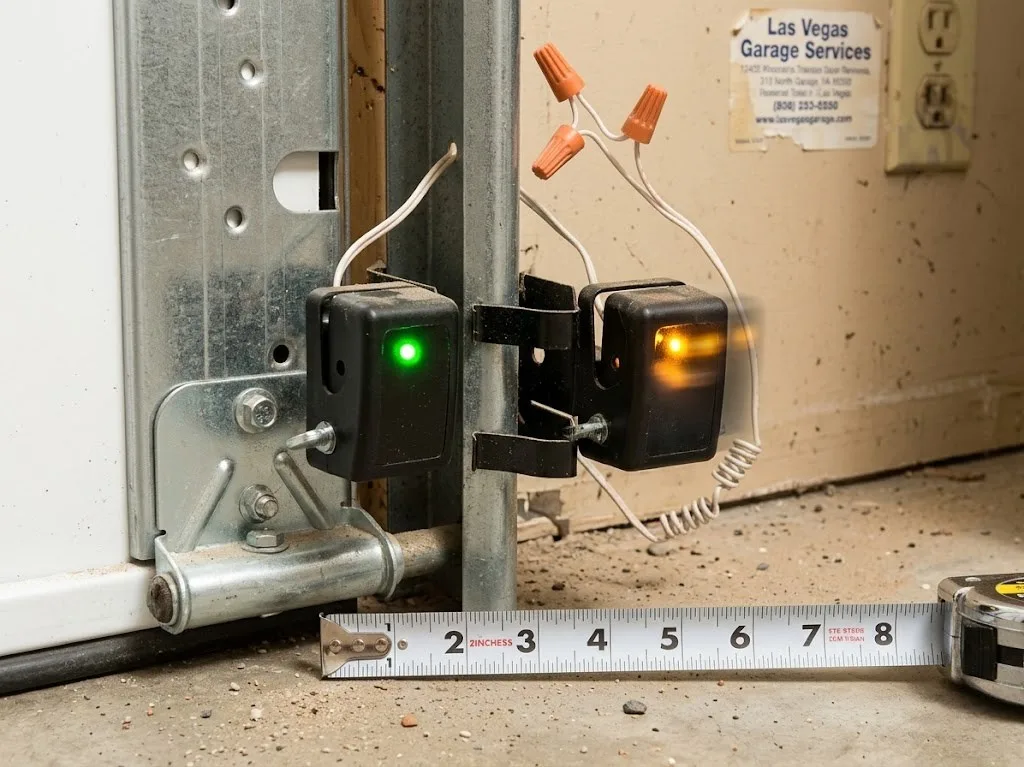
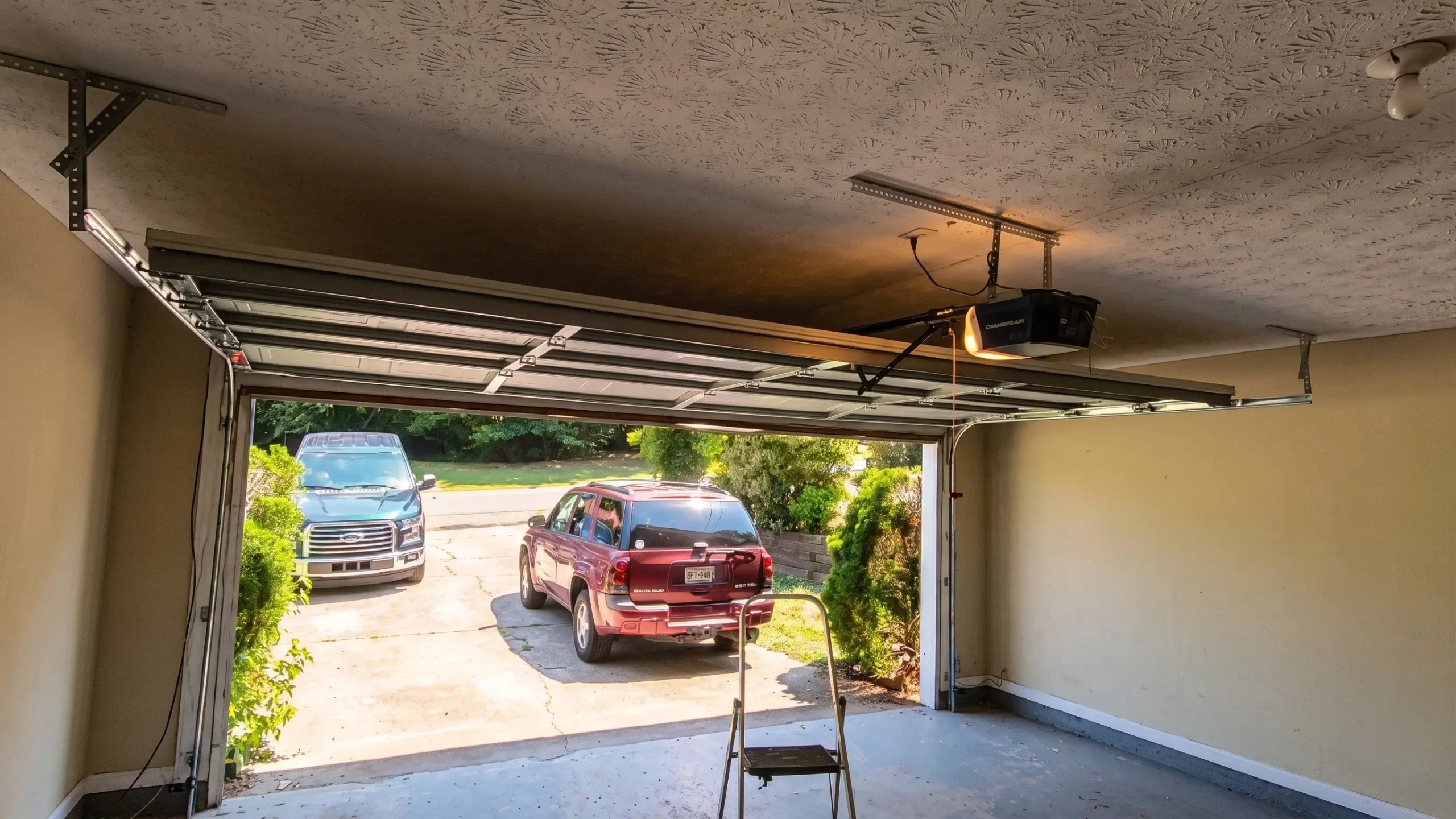
Here’s the real picture. Your garage door weighs between 130 and 400 pounds. The lift cables run from the bottom corners of the door, up and around the cable drums mounted on the torsion shaft above. When the spring winds up, the cables pull the door up. When it unwinds, the cables control the descent. Remove the cables from that equation, and you’ve got a heavy slab with nothing to keep it from free-falling.
TECH NOTE
There are two cable types in most residential doors. Lift cables are the working muscles they carry the load every cycle. Safety cables run through extension springs and act as a catcher if the spring snaps. Both matter. Most homeowners only ever think about the lift cables because those are the ones that fail visibly.
A standard residential cable is rated for 10,000 to 15,000 cycles. One cycle = one open + one close. Average Las Vegas household runs 4–6 cycles a day. Do the math you’re looking at a 7–10 year lifespan before replacement becomes overdue.
The drum groove is where I see the most premature wear. The cable winds onto a grooved drum, and if the spring tension is slightly off which happens as springs age the cable starts riding incorrectly. One strand kinks. Then another. The whole thing is still holding, but it’s running on borrowed time. Most homeowners never see it coming.
Why Las Vegas Destroys Garage Door Cables Faster Than Almost Any Other City
I’ve worked in other states. I’ve talked to techs from Atlanta, Chicago, Portland. None of them deal with what we deal with here. Las Vegas is genuinely hostile to garage door components, and cables take the worst of it.
The Heat Factor
When temps hit 110°F and above which is June through August every single year the metal in your cables expands. The lubricant on the drum grooves thins out and drips away. The cable wraps unevenly. Over a few summers, that uneven winding grooves the drum in the wrong places, and now the cable is cutting against metal instead of riding smoothly through it.
“I replaced cables on a 12-year-old Summerlin home last July. The original cables had almost no visible fraying but the drum grooves were worn so deep you could feel them with your fingernail. The cable would have snapped within weeks.” Ray Dominguez, A1 Local Garage Door
Desert Dust and Grit
Dust here isn’t just cosmetic. Fine desert grit gets into every moving part. It mixes with cable lubricant and becomes a mild abrasive. Every open and close, the cable is dragging through a compound that slowly sands through individual wire strands. It’s slow, invisible destruction. By the time a strand visibly pops, there are already micro-fractures in three or four others.
Monsoon Moisture and the Spring Connection
Late summer brings humidity spikes. Cables and springs absorb that moisture. The galvanized coating that protects the steel wire from rust can only do so much. When springs corrode and weaken, they put uneven load on the cables. A deteriorating torsion spring is almost always responsible when I find premature cable failure in an otherwise young door. They don’t fail independently — they drag each other down. [INTERNAL LINK: garage door spring replacement in Las Vegas → /las-vegas-nv/garage-door-spring-replacement/]
Las Vegas Homeowner Warning
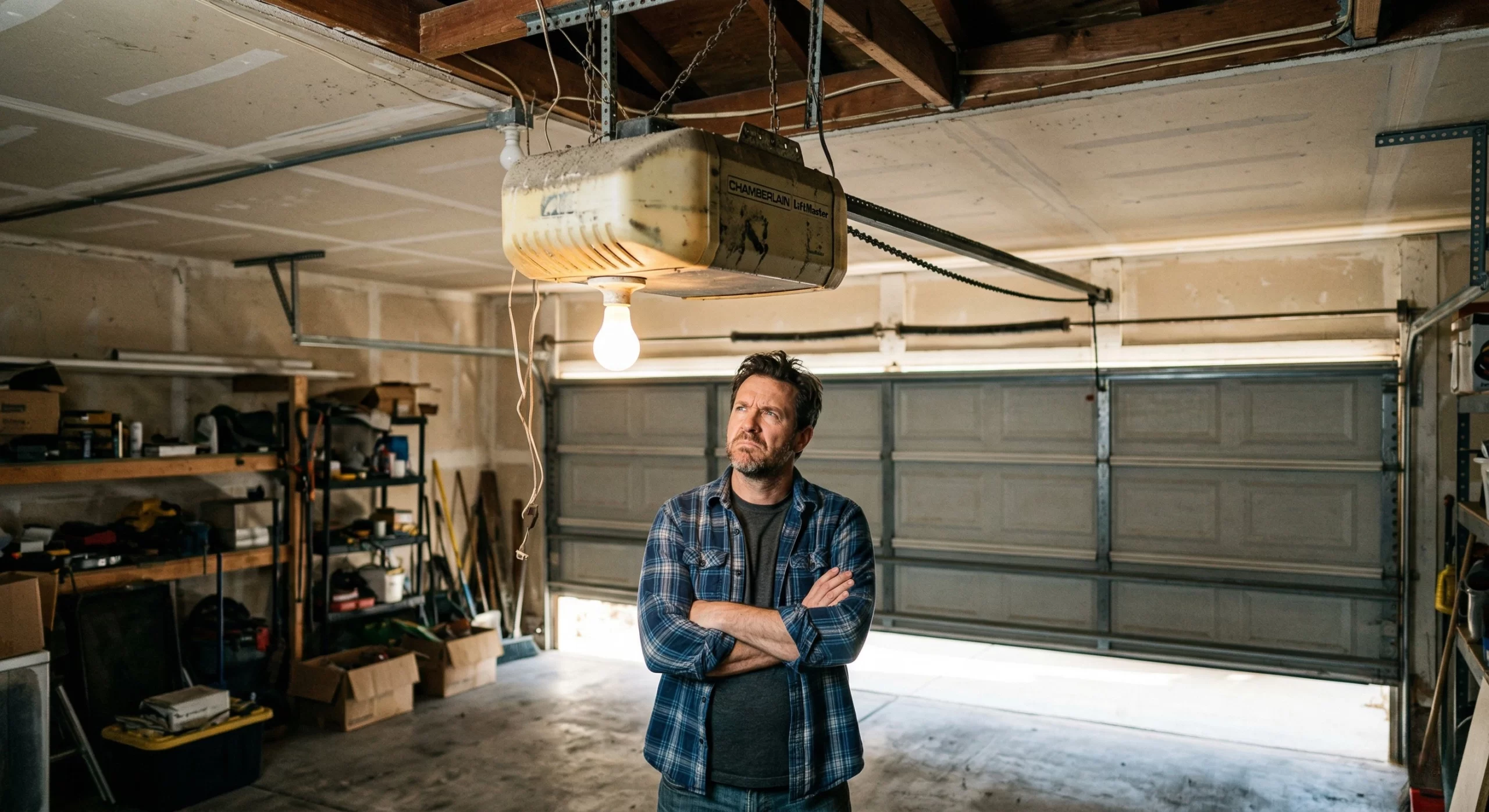
Most homes in Henderson, Summerlin, North Las Vegas, and the 89147 zip code were built in the late 1990s to early 2000s. Those original builder-grade lift cables are now 20–25 years old. They’ve survived somewhere between 25,000 and 45,000 cycles. They are statistically overdue.
If your home is that age and you’ve never had the cables inspected this guide isn’t just informational. It’s a heads-up.
6 Signs Your Garage Door Cable Is Failing Right Now
Twenty years of service calls has drilled these into my head. Some are obvious. Most homeowners miss the subtle ones until the door stops moving entirely. Here’s what to look for:
Door hangs lower on one side: The most obvious sign. One cable has more slack than the other. The door looks tilted, especially when partially open. Don’t keep operating it you’re putting lateral stress on the tracks and bottom brackets.
Visible fraying or loose wire strands: Shine a flashlight along the cable. If you see individual strands that look like “hairs” sticking out of the main line that’s internal failure breaking through. The cable has already lost structural integrity. Stop using the door immediately.
Cable lying coiled on the floor or piled in a corner: This is what happens after a complete snap. The spring releases all its stored tension, the cable releases and piles up. The door is now dead weight. Do not try to manually lift it a 200-pound door with no counterbalance will drop without warning.
Door shudders, jerks, or moves unevenly: If the door stutters going up or down, one cable may be slipping or fraying on the drum. It’s often mistaken for an opener problem. If the opener sounds fine but the door moves wrong look at the cables first.
Loud bang followed by door failure: You hear a noise like a gunshot from the garage. Sometimes the spring, sometimes the cable anchor releasing under load. Either way call before going near that door. Both components store enormous energy and can cause serious injury when they let go unexpectedly.
Cable has slack when the door is fully closed: With the door down, both cables should have slight tension not tight, but not hanging loosely either. Excess slack means the cable has stretched, the spring tension is off, or the cable has started to unspool from the drum groove.
Quick Self-Check (Do This Safely)
Stand in front of your closed garage door and look at the vertical cables on each side. They should be roughly parallel and symmetrical. If one looks shorter, longer, or has visible slack that’s your starting point for a tech call. Never pull or prod the cables by hand. They’re connected to a spring under hundreds of pounds of stored tension.
Why Garage Door Cable Repair Is Never a DIY Job No Exceptions
I’m going to be direct here. I’ve seen what happens when someone watches a YouTube video and decides to swap their own cables. I’ve also seen the ER reports. This is not an exaggeration to sell you on professional service it’s twenty years of watching what goes wrong.
The cables connect directly to the torsion spring assembly. That spring stores between 150 and 350 foot-pounds of torque depending on door size and weight. Releasing that tension incorrectly can cause the spring to snap, the winding bar to kick back, or the cable to whip. A cable under that load traveling at speed will cut through skin and crack bone.
Safety Reality Check
Nevada requires a contractor license from the NSCB for garage door work. Any tech who shows up without one is working illegally. If something goes wrong injury, property damage you have no recourse. Verify the license number at nscb.nv.gov before any tech touches your door. This protects you, not just the tech.
The tools required for safe cable replacement winding bars, locking pliers, cable crimpers, tension gauges are not common household items. Even when someone has the tools, proper spring tension calibration requires experience. Get it wrong and the cables re-fail within weeks, or the door is so heavy it strains the opener motor on every cycle.
Every time I’ve been called to fix a DIY cable job, the bill ends up higher than if the homeowner had called a tech first. That’s not a coincidence. A door that went off-track or a drum that got damaged during an amateur repair costs more to fix than the original cable alone. garage door off-track repair Las Vegas.
What Actually Happens During a Professional Garage Door Cable Repair
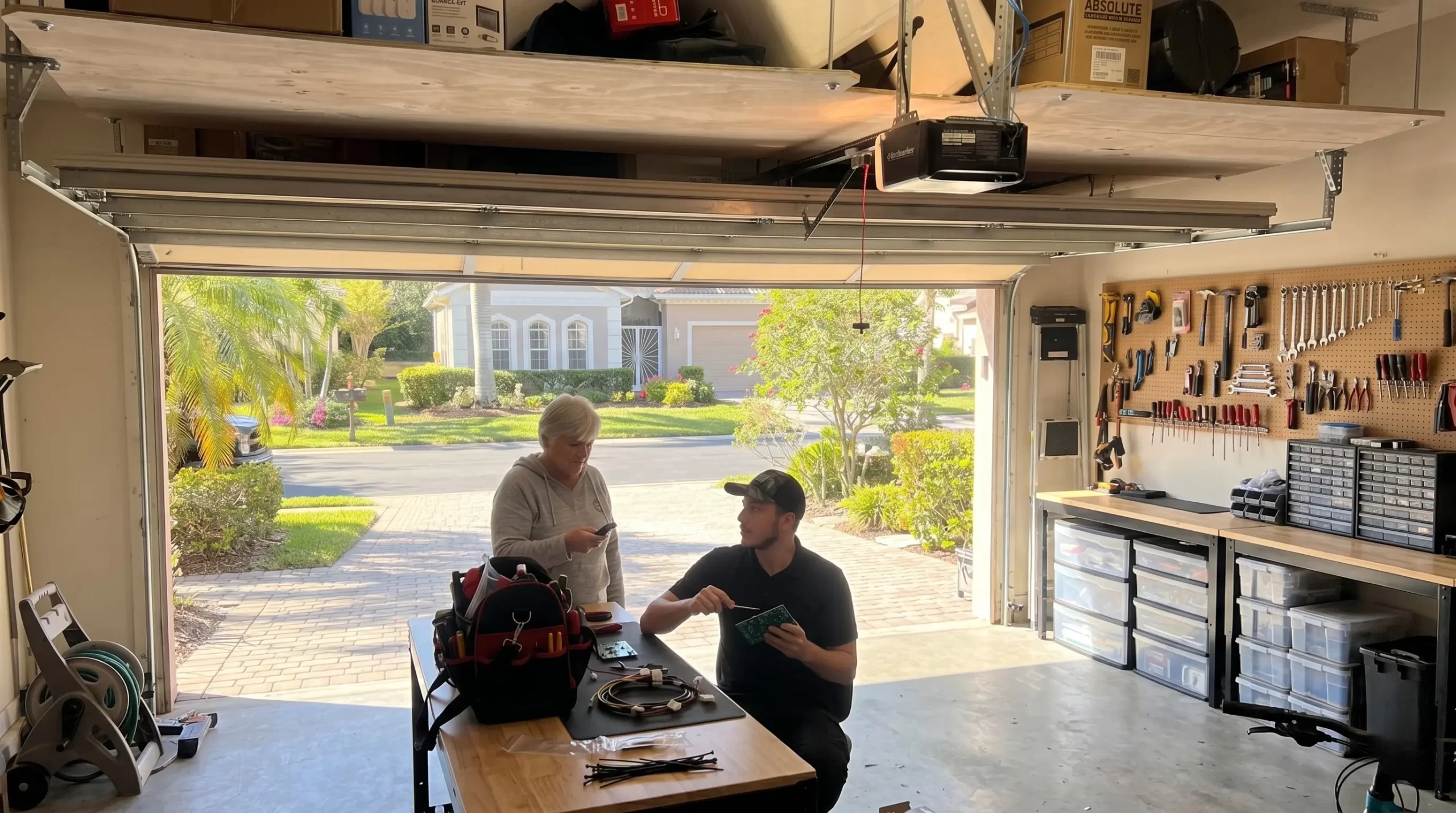
Most homeowners have no idea what they’re paying for when a tech does cable work. I’ll walk through exactly what I do on a standard cable repair call because informed customers make better decisions, and better decisions mean fewer callbacks.
Step 1: Full Visual Diagnosis Not Just the Cable
Before I touch anything, I inspect the entire lift system. Cable drums, drum grooves, cable anchors, bottom brackets, spring condition, and opener tension settings. A cable didn’t fail in isolation — something allowed it to fail, and I need to find that first.
Step 2: Spring Tension Release The Critical Step
The spring must be completely unwound before any cable work begins. This is done with winding bars at the spring cone. A tech who skips this step or rushes it is the one who ends up in the ER. I release the tension, clamp the door, and verify there’s zero stored energy before proceeding.
Step 3: Cable Removal, Drum Inspection, Replacement
The old cable comes off the drum and anchor. I inspect the drum groove for wear patterns if it’s grooved deep, I replace the drum too. A worn drum groove will destroy a new cable in 18 months. New cable gets seated into the groove correctly and secured at the bottom bracket anchor point.
Step 4: Spring Re-Tension and Balance Test
The spring gets re-wound to the correct turn count for the door’s weight and height. Then I do a balance test: disconnect the opener, manually lift the door to waist height, let go. A properly balanced door stays put. It shouldn’t crash down or spring up. If it does, the tension is wrong.
Step 5: Full System Cycle and Adjustment
Opener re-engaged, door cycled 4–5 times while I watch for cable tracking, listen for rubbing, check the drums are winding evenly. Limit adjustments made if needed. Force settings checked. I hand you a written report of everything I found and fixed, and everything that’s worn but not yet failed.
The whole job runs 45 minutes to 90 minutes on a standard single-car door. Double-car with dual torsion spring adds time. If both cables are replaced at once which I almost always recommend the labor overlap makes it significantly more cost-effective than returning for the second cable a year later.
How to Find the Best Rated Garage Door Cable Repair in Las Vegas Without Getting Burned
Las Vegas has a lot of garage door companies. Some are excellent. Some are fly-by-night operations running out of an unmarked van with no license. The best rated companies are easy to identify if you know what to ask.
The 6-Question Hiring Checklist
Do you hold a Nevada contractor’s license from the NSCB?
Ask for the number. Verify it at nscb.nv.gov. Takes 60 seconds. Unlicensed techs leave you legally unprotected.
Will you give me a written quote after diagnosis, before work starts?
Any reputable company does this without hesitation. If they quote a price on the phone without seeing the door, that number will change once they’re in your driveway.
What is the trip fee, and is it applied toward the repair?
At A1 Local Garage Door, the $49 trip fee is credited toward the repair. That’s standard among legitimate companies. If a company charges a trip fee AND a separate labor fee on top press them on that.
Do you stock cables and drums on your truck?
Best rated companies carry the most common parts. A tech who needs to “order the part” for a standard cable replacement either doesn’t know the trade or doesn’t invest in their inventory.
Do you recommend replacing both cables at once?
If one cable failed, the other is the same age and has the same wear. A tech who only replaces the broken one is either cutting corners or setting themselves up for a callback. Both should come off together.
What warranty do you provide on parts and labor?
Legitimate repair comes with a warranty. Ask for it in writing before work begins.
Red Flags That Should Stop You Cold
| What They Say or Do | What It Means | Walk Away? |
|---|---|---|
| Quotes exact price on the phone without asking door size | Price will change on-site | Yes |
| Can’t provide a license number | Unlicensed zero recourse if something goes wrong | Yes |
| Says cable repair requires full door replacement | Either wrong or upselling cables are standalone components | Yes |
| Won’t put quote in writing before work starts | Price gets negotiated after your door is already in pieces | Yes |
| Mentions what’s worn without pressure after diagnosis | Honest tech doing a thorough inspection | Good sign |
| Answers live at 9pm on a Sunday | Real 24/7 operation, not an answering service | Good sign |
One More Thing Worth Knowing
The best rated garage door companies near me in Las Vegas the ones with consistent 4.8+ star reviews almost all share one trait: the tech who does the repair is an employee of the company, not a subcontractor. Subcontractors vary wildly in skill and don’t carry the same accountability. Ask directly: “Is the tech your employee or a sub?” At A1 Local Garage Door, every tech is in-house. No exceptions.
If your door is already in full emergency failure cable snapped, door stuck, car trapped don’t spend time shopping around. Call a 24-hour service, get the door operational, then evaluate the company after. same-day emergency garage door repair Las Vegas.
FAQ
How long does garage door cable repair take in Las Vegas?
Most single-door cable repairs take 45 to 90 minutes start to finish. Double doors with dual spring systems run closer to 90 to 120 minutes. What affects time most is whether the drums need replacement alongside the cables something a good tech assesses during diagnosis before touching anything.
Should I replace both cables even if only one broke?
Yes, always. Both cables are the same age, have run the same number of cycles, and have been exposed to the same Las Vegas heat and desert conditions. The one that didn’t snap yet is at the same failure point. Replacing both at once costs marginally more in parts but saves you a full service call when the second one fails usually within months.
Can I manually open my garage door if the cable broke?
No. With a broken cable, the door has no counterbalance and is full dead weight. Manually lifting a 200-pound door without counterbalance strains the opener, can bend the track, and drops without warning if your grip slips. Leave it closed until a tech arrives. If your car is inside, call for same-day or emergency service most Las Vegas companies, including A1, have technicians dispatching within 1–2 hours.
How much does garage door cable repair cost in Las Vegas?
Costs vary based on door size, cable type, and whether drums need replacing. Any specific quote over the phone before seeing the door is not trustworthy. What you should always receive is a written quote after diagnosis and before any work begins. A $49 trip fee is standard at most reputable Las Vegas companies and is credited toward the repair.
How often should garage door cables be inspected in Las Vegas?
Annual inspection is the right standard for any Las Vegas home more frequently for homes 15+ years old. Desert heat, UV exposure, and summer humidity all accelerate wear on galvanized steel cables faster than national averages suggest. An annual tune-up catches cable fraying, drum groove wear, and spring tension drift before any of them become emergency failures.
What’s the difference between a lift cable and a safety cable?
Lift cables are the load-bearing cables that run from the bottom corners of the door up through the cable drums they do the actual lifting. Safety cables thread through the center of extension springs and act as a containment wire if the spring snaps. Both matter. Lift cables fail more commonly, but a missing or frayed safety cable on an extension spring system is a serious injury risk.