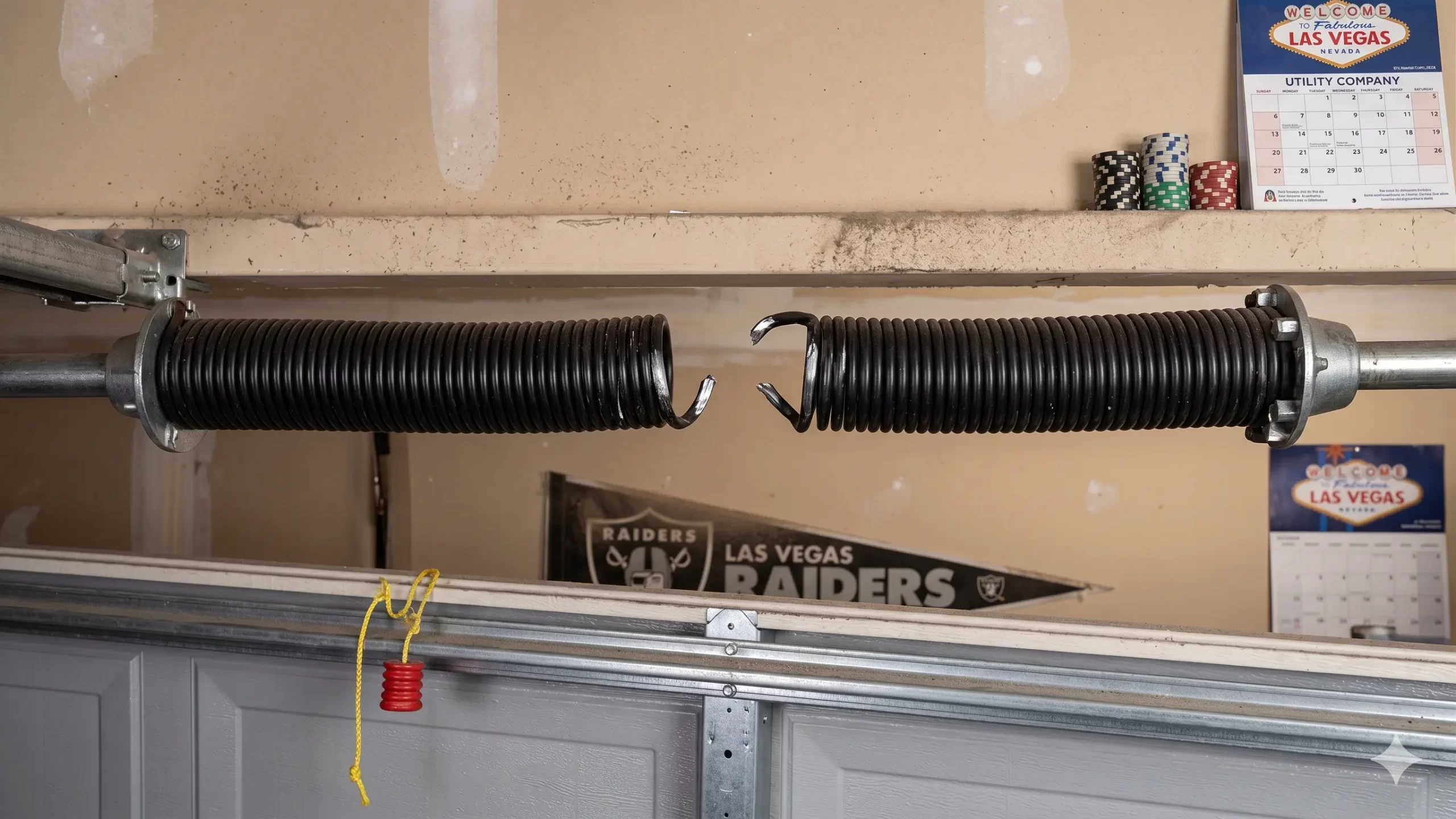
That loud bang you heard at 6am was not your imagination. Here is what happened, why it happens more in Las Vegas than anywhere else, and what to do next.
A garage door spring failure is one of the most dramatic things that can happen in a quiet house. There is a sound like a gunshot. The door goes dead. And suddenly your car is trapped inside. This happens across Las Vegas every single day and for very specific reasons tied to the desert climate. If you are already dealing with a broken spring and need a technician, visit our garage door repair in Las Vegas page to book same-day service.
This guide is written by Shlomi Perets, a garage door technician with 14 years of field experience across Las Vegas, Henderson, Summerlin, and North Las Vegas. He has replaced hundreds of springs across the valley and explains here exactly why they fail, when yours is likely to go, and what to do about it.
What Are Garage Door Springs and What Do They Actually Do?
Your garage door weighs between 150 and 300 pounds depending on the material and size. Without springs, your opener motor would have to lift that entire weight every single time. Springs do the heavy work — the opener just guides the movement.
There are two types of springs used on residential garage doors in Las Vegas. Understanding the difference matters because they fail differently and cost different amounts to replace.
Torsion Springs: Standard on Most Las Vegas Homes
Torsion springs mount horizontally above the garage door opening on a steel shaft. When the door closes, the spring winds up and stores energy as coil tension. When the door opens, that stored torque unwinds and helps lift the door. Most Las Vegas homes built after 1995 use torsion springs. They last longer, operate more smoothly, and are safer when they break because the coil stays on the shaft.
Extension Springs: Found on Older Las Vegas Homes
Extension springs run along the sides of the door, parallel to the horizontal tracks. They stretch and contract as the door moves. Older Las Vegas homes pre-1995 builds often have extension springs. They wear out faster and are more dangerous when they snap because the released spring can fly across the garage if a safety cable is not installed.
How Long Do Garage Door Springs Last in Las Vegas?
Standard torsion springs are rated for 10,000 cycles. One cycle equals one full open and one full close. That sounds like a lot. It is not.
Calculate How Many Years Your Springs Have Left
- 2 uses per day: 3,650 cycles per year → 10,000 cycles lasts about 2.7 years
- 4 uses per day: 1,460 cycles per year → 10,000 cycles lasts about 6.8 years
- 6 uses per day: 2,190 cycles per year → 10,000 cycles lasts about 4.5 years
- 8 uses per day: 2,920 cycles per year → 10,000 cycles lasts about 3.4 years
A household with two working adults, kids going to school, and weekend errands easily hits 6 to 8 cycles per day. That means standard springs last 3 to 5 years not the 7 to 10 years most people assume.
Las Vegas adjustment: In the desert climate, extreme heat and cold cycles add mechanical stress beyond the cycle count. Shlomi estimates that Las Vegas springs reach end of life 15 to 20 percent earlier than the rated cycle count in moderate climates. A spring rated for 10,000 cycles may fail at 8,000 here.
What Are the Real Causes of Garage Door Spring Failure in Las Vegas?
Most spring failures come down to the same handful of causes. Some are unavoidable. Some are completely preventable with basic maintenance.
Cause 1: Normal Cycle Wear and Metal Fatigue
Every time the spring winds and unwinds, microscopic stress builds in the metal coil. This is called metal fatigue. It is the same process that causes a paper clip to snap when you bend it back and forth. There is no way to stop it only slow it down. Eventually every spring reaches the point where one more cycle causes it to break.
In Las Vegas this process accelerates because the metal expands in summer heat and contracts in cool winter mornings. That daily expansion and contraction adds stress cycles beyond what the door use count alone accounts for.
Cause 2: Las Vegas Temperature Swings
Las Vegas temperatures range from below 35°F on winter nights to above 115°F in July. That is an 80-degree swing. Steel expands when hot and contracts when cold. Torsion springs go through this thermal expansion and contraction every single day regardless of whether the door is used.
The most dangerous moment is early morning during cold weather. Metal is at maximum contraction and the spring is at its tightest. Most Las Vegas spring failures happen between 5am and 8am in November through February when temperatures are lowest and a homeowner is heading to work.
Cause 3: Lack of Lubrication
A dry spring coil generates friction between the metal wire strands as it winds and unwinds. That friction adds heat and accelerates wear at the microscopic level. A well-lubricated spring runs cooler and lasts significantly longer.
In Las Vegas, the low humidity means springs do not rust as often as in coastal cities. But the dry air also means lubrication evaporates faster. Springs need to be lubricated every 6 months in the desert twice as often as in humid climates where moisture provides some natural protection.
- What to use: White lithium grease or a silicone-based spray. Apply to the coils, not the ends. Never use WD-40 as a lubricant it strips existing grease and leaves the coils dry within days.
Cause 4: Wrong Spring Size for the Door Weight
Every garage door has a specific weight. Springs are engineered to counterbalance that specific weight. When a builder installs a lighter spring to cut costs which happens often in Las Vegas tract home construction the spring carries more load than it was designed for. Every cycle puts it under stress beyond its rating.
Shlomi finds under-spec springs regularly in Las Vegas homes built between 1998 and 2008. The door appears to work fine for years until the spring hits its accelerated failure point. A technician can check whether your spring is correctly sized for your door weight during any service call.
Cause 5: Rust and Coil Corrosion
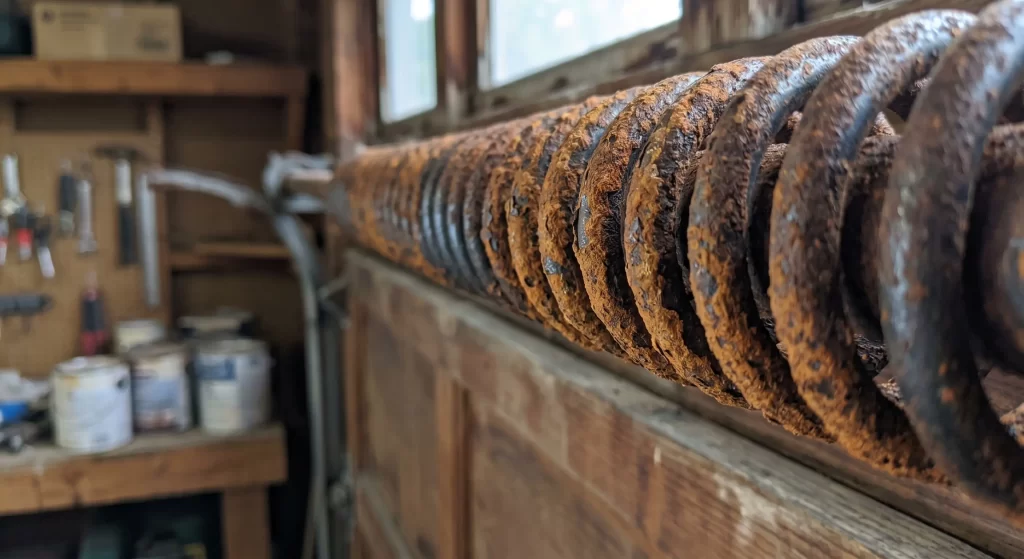
Las Vegas has low annual humidity but it is not rust-free. Monsoon rain in July and August, sprinkler overspray, and moisture from vehicles bring water into the garage. That water sits against the spring coils especially near the bottom of the coil where water pools.
Rust increases friction between coil strands, which accelerates wear in the same way dry springs do. Rust also pits the metal surface, creating stress concentration points where cracks form. A spring with visible orange-brown rust on the coils is close to failure even if it still operates.
What Are the Warning Signs a Garage Door Spring Is About to Break?
Springs rarely fail with zero warning. Most show symptoms for weeks before the final snap. Catching these signs early means you can schedule a replacement on your terms — not at 6am on a Monday.
- The door feels heavier than usual: This is the clearest sign. Springs are losing tension and no longer counterbalancing the door’s full weight. The opener strains. You can feel it in the resistance if you try to lift manually.
- The door moves unevenly or tilts to one side: One spring is weaker than the other. The door hangs lower on the failing side. Left unchecked, this stresses the cables, rollers, and tracks on the weaker side.
- Visible gaps in the spring coil: A gap in the torsion spring coil means it has already partially failed. The coil is separating under stress. This spring will snap completely very soon — do not keep using the door.
- Squeaking or grinding sounds during operation: A spring low on lubrication or developing surface rust generates noise as the coils rub together. This is a maintenance warning, not immediate failure, but it should be addressed within the month.
- The door opens a few inches and then stops: The opener is straining against a weakening spring and shutting down to protect the motor. This is the opener’s auto-reverse safety function detecting excessive load.
- Loud creaking at the top of the door travel: The spring reaches maximum unwind tension at full open. A spring near failure makes a sharp creaking or popping sound at the top of the arc just before the door stops.
Shlomi’s field observation: When I show homeowners the gap in their spring coil, most say they noticed the door was getting harder to open for the past few weeks. They assumed it was the opener. It was always the spring. The opener was just compensating until it could not anymore.
Can You Open a Garage Door With a Broken Spring?
You can try but whether you should depends entirely on what you feel when you test the door weight.
Pull the red emergency release cord hanging from the opener track. This disconnects the door from the opener carriage. Then grip the door at the bottom and try to lift it slowly. A door with a working spring should lift with about 8 to 10 pounds of effort. A door with a broken spring requires you to lift 150 to 300 pounds of raw panel weight.
STOP if the door is heavy: If lifting requires real effort or the door will not stay open on its own, put it back down immediately. Lifting a full door weight without spring assistance risks back injury and if you lose grip, the door drops at speed onto whatever or whoever is underneath it.
If the door is too heavy to open manually, your car is trapped until the spring is replaced. Do not try to force it. For same-day help across Las Vegas, call us or visit our emergency garage door repair in Las Vegas page
Should You Replace One Spring or Both at the Same Time?
This is one of the most common questions Shlomi gets on a service call and the answer is always the same.
Replace both. Every time.
Here is why. Springs are installed in pairs on the same day, using the same batch of metal, wound to the same tension. They wear at the same rate. When one breaks, the other has gone through an identical number of stress cycles and is carrying additional load from compensating for the failed spring. It is weeks or months from its own failure not years.
Replacing only the broken spring costs slightly less today and guarantees a second service call within the year. Replacing both in a single visit costs only marginally more in labor since the tech is already on-site with the tools set up. A1 Local Garage Door always replaces both springs as a standard practice. See what our garage door spring replacement in Las Vegas service includes and how fast we can get to you.
Should You Upgrade to High-Cycle Springs in Las Vegas?
Standard springs are rated for 10,000 cycles. High-cycle springs are rated for 20,000, 30,000, or even 50,000 cycles. For Las Vegas homeowners, this upgrade makes more sense than in most cities.
Why High-Cycle Springs Make Sense for Las Vegas
- Desert heat adds stress cycles: Every day of extreme temperature swing adds fatigue beyond the usage count. High-cycle springs use thicker wire and more coils to distribute that stress across more metal surface area.
- Frequent use households: If your garage door is used 6 or more times per day by multiple drivers, high-cycle springs pay for themselves within the first replacement cycle.
- Cost difference is small: A high-cycle spring upgrade typically adds $50 to $100 per pair at installation. That cost avoids one full service call — saving $150 to $350 within 3 to 5 years.
- Better suited for Las Vegas tract homes: Most builder-grade doors in Las Vegas were installed with minimum-spec standard springs. Upgrading to high-cycle when you replace means the next set lasts significantly longer.
Ask the technician about high-cycle options when you book. Not every company stocks them. A1 Local Garage Door carries high-cycle springs in the most common sizes on every truck.
How Much Does Garage Door Spring Replacement Cost in Las Vegas?
This is the question every homeowner asks before calling. Here are the real numbers not vague ranges.
- Standard torsion spring replacement (both springs): $150 to $350. Includes both springs, labor, and a full safety check of cables, drums, and door balance after installation.
- High-cycle spring upgrade: Add $50 to $100 to the above. Worth it for frequent-use households or doors with a history of early spring failure.
- Extension spring replacement: $100 to $200 for the pair. Less common on newer Las Vegas homes but standard on pre-1995 builds.
- Trip fee: $49 applied toward your repair total. You get a written quote after diagnosis before any work starts.
No after-hours markup: A1 Local Garage Door does not charge inflated rates for evening or weekend service. The cost you pay is for the part and the labor. A broken spring at 6am on a Saturday costs the same as a broken spring at 2pm on a Tuesday.
FAQs
How long do garage door springs last in Las Vegas?
Standard torsion springs are rated for 10,000 cycles — one cycle equals one full open and close. At 4 uses per day, that is roughly 7 years. In Las Vegas, extreme heat and cold cycles cause metal fatigue faster than the national average. Most Las Vegas homeowners see spring failure between 5 and 9 years, depending on usage frequency and whether the springs have been lubricated regularly.
What does it sound like when a garage door spring breaks?
A snapping torsion spring makes a loud bang often described as a gunshot or firecracker going off inside the garage. It is sudden and sharp. If you hear this sound and the door then feels extremely heavy or will not open, the spring has broken. Most Las Vegas spring failures happen in early morning hours between 5am and 8am when overnight temperatures are at their lowest and metal contraction is at its tightest.
Can I open my garage door with a broken spring?
You can pull the emergency release cord and lift the door manually, but only if it feels light under 10 to 15 pounds of resistance. A properly balanced door should lift easily. If it feels very heavy, stop immediately. Without the spring counterbalancing the door weight, you are lifting 150 to 300 pounds of door panel. This causes back injuries and if you lose grip, the door drops fast and hard.
How much does garage door spring replacement cost in Las Vegas?
Standard torsion spring replacement in Las Vegas runs $150 to $350. The price includes both springs replacing only one is not recommended since paired springs wear together. High-cycle spring upgrades (20,000 cycles or more) add $50 to $100 but last significantly longer in Las Vegas heat. A1 Local Garage Door charges a $49 trip fee applied toward repair, with a written quote before work starts.
Should I replace both garage door springs or just the broken one?
Always replace both springs at the same time. Paired springs are installed together and wear together. When one breaks, the other is close behind usually within 6 to 12 months. Replacing both in a single visit costs only slightly more than replacing one, and it prevents a second service call and a second stuck door situation within the year.